Monday, October 11, 2010

Monday=Book Review Time--Another impressive debut novel

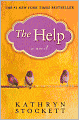
Up for today: The Help by Kathryn Stockett (This review requested by Mary Kay.)


Why I bought it? Several friends had recommended it, and I'd heard a lot of buzz online about it, so I downloaded it to my Kindle.

Synopsis: Set in the early 1960s in Jackson, Mississippi, the book follows the lives of 3 women, two black maids, Aibilene and Minny, and one white woman newly graduated from college, Skeeter. In alternating chapters each woman tells her own story. Eventually, they come together to work on a super-secret project--one that exposes the hidden lives of the well-to-do whites, and, of course, fallout ensues.

What I thought? I enjoyed this book immensely. I found the way the dialect was written at the beginning very off-putting, but after a while I got used to it. (A friend said that she had listened to it on CD and that the reading was wonderful--which would take care of the crazy spellings, etc. If I had it to do over again, I'd listen to it.) That said, the dialect itself was spot on, and, having grown up in the south, I'm a hard one to fool on southernisms. The food (oh my gosh, it made my mouth water), the weather, the names (I even had a friend in high school whose nickname was Skeeter), the set up of the houses, the interaction of the classes and races was all well done. It's obvious the author knows the south.

The characters are so engrossing that the book is very hard to put down. There's tons of humor and plenty of poignant moments, too. These characters have stayed with me even though sometimes I wish there had been more rounding out of the white characters. (I know there were plenty of mean white women with maids and insensitive ones and oblivious ones, but there were also kind ones and ones that were mean sometimes and kind other times. It would have been nice to see more of those.) A great first book for this author and a nice one for book clubs.

My rating: **** out of 5. Up until about 3/4 of the way through, it was 4 1/2 to 5, but I feel like Skeeter's story got the bum's rush at the end. I still recommend it highly because her story wasn't my favorite part. I loved the tales from "the help." They were priceless, and I wouldn't be surprised if every single one of them really happened somewhere.

Cleanness Score: 5 out of 10, This is kind of vague in my head because it was back in January that I read it, but I don't remember anything very offensive. There was some physical abuse and language and a lot of adult themes, but this is another book intended for grown ups that teens could easily read.

FYI: They are making a movie of it that will be out next year. It will be interesting to see how they put it on the big screen.

Friday, October 8, 2010

Friday's Photolife--What's your angle

Wednesday's answer: Sorry, there were no winners. I didn't realize this would be so tricky. It was an icehouse. Fill it up all winter, and you have ice throughout the spring and summer. Cool, huh? This particular one was Jefferson's at Monticello.

On to the Photolife:

Do you always take pictures straight on? Here's one (mostly straight on) at a WWII memorial in Annapolis, MD.
How does the impact of the picture change when shot from a side angle?
Do you think about your vantage point when taking pictures? Try it sometime. No fancy equipment required. Just break out your point and shoots. This is more about where you put yourself and the camera.
Shoot from above (I was on a balcony above my cute nephew.)
or below (I knelt at the bottom of the column that was part of James Madison's icehouse.)
or dog level. (I held the camera down around my ankles and clicked--talk about literally pointing and shooting.)
Take this colorful street.
Think about how the angle changing
alters what the picture says or your reaction to it.

Application to writing? Telling stories from different points of view can dramatically or subtly change the impact of what you're saying. If a scene isn't working for you, try it from a different POV or, if you'd rather keep your story at one POV character, try giving him a different perspective. e.g. For one scene in my WIP I had my POV character on a balcony overlooking the action on the street below rather than at street level. Think about how her perspective would have been different if I'd put her looking out a basement window.

Wednesday, October 6, 2010

What in the world?

What is it?
Here's a view through the bars.

Good luck!

Hint: Wealthy people often used to have them.

Monday, October 4, 2010

Monday=Book Review Time--translating life

Up for Today: Girl in Translation by Jean Kwok (This review requested by Yat-Yee Chong.)

Girl In Translation

Why I bought it? It was September's read for my book club, and I downloaded it onto my Kindle.

Synopsis: Kimberly Chang is a brilliant student, but, when she and her mother arrive in New York City from China, she can only speak her 5th grade English--i.e. not much--and her mother speaks none. Beginning 6th grade is a challenge to say the least. They live in an apartment in a condemned building (lots of companionable roaches and rats and no heat)--arranged by her mother's sister. (With family like her who needs enemies?) They work in the sweatshop of the aforementioned loving sister and her husband and survive as best they can. I don't want to give any more away, because this story is lovely to discover as you read. If you want a bit more, you can go to Jean Kwok's synopsis on youtube.

What I thought? I loved this book. The writing is beautifully wrought--amazing for anyone but especially someone who's first language was not English. What an incredible debut novel. It is vivid like nobody's business. There is such authenticity to it that sometimes it feels like memoir (and at times perhaps it was a bit. Kwok did experience some of the same things when she moved to NYC from China.) I was completely transported. I cried and laughed, mourned and rejoiced along with Kim. The way Kwok deals with Kim's fragmented understanding of English (at first) is so well done that it brought back my own experience learning French. I'm in awe of Kwok's writing. Awe, I tell you.

My Rating:****1/2 out of 5, It was almost a 5, but there were a few things that held it back. Still a fabulous read.

Cleanness Score: 4 out of 10, for some mild language, some incidental drug use, and a not over done sex scene. This is a book intended for adults, but I think most older teens would be fine reading it.

Friday, October 1, 2010

Friday's Photolife--to flash or not to flash

Wednesday's answer and winner: Erinn guessed a beach in South Carolina. That's as close as it got without being wrong. So congrats to Erinn. The full answer is Hilton Head Island, SC. The greens in the hint was for all the golf courses. The 2nd picture highlights the tidal wetland, and the 3rd picture is for the spanish moss that you see everywhere there. Savannah, GA, from Samantha Bennett, was actually a very good guess. It's not very far from Hilton Head and has some significant similarities.

While I was taking pictures there one night, I had a bit of a dilemma. It was almost dark and the building with the indoor pool was beautifully reflected in the small pond encircling it. To flash or not to flash? I tried both. You may be surprised to find out that the first picture is the one
with flash
and the 2nd is without. The light wasn't able to reach the building before the shutter closed so the only thing that caught the light from the flash is the grass. For the second I leaned against a pole to hold the camera steady. With a flash on you lose most of the natural light in your shot.

Sometimes that's what you really want to show. Here's an example from Disney World's Magic Kingdom.
With the flash you see all the details of the railing and the golds and grays of the stage, but there's no way that you would know that
the archway was lit up with blue light. Without the flash you see that but can't make out the same level of details. As a photographer you have to decide which one you prefer or take both (which is what I usually do) and use both later for something like this. You know I'm always thinking of you.
With--you show the bellhop directing people to the elevator in the Tower of Terror,
or--without--you create a ghostly vision of the same scene.
With--you show the exact material of the ball at Epcot,
or--without--you emphasize how the ball glows.
With--you show how the path at Epcot is made with some paving stones that seem to sparkle,
or--without--you show how they light the path in the darkness.

When we take pictures, we are always faced with this choice (whether we realize it or not).

Application to writing? When setting a scene, we should decide what we want our description to do: give specific details of the surroundings or set a mood.

Wednesday, September 29, 2010

Where in the world?

On Friday's post someone asked where I took those pictures. You know that's going to lead to--Where in the world was Lotusgirl?
So... See if you can figure it out with these picture clues.
Be as specific as you can.

Good luck!

Hint: There are lots of greens there.

Friday, September 24, 2010

Friday's Photolife--Fogging up

Wednesday's update and answer: Anette was the first to guess the Louvre on Wednesday's post, and Jenna was the first to reference the "big glass triangle." No one actually gave me the name though. It's part of Les Pyramides or The Pyramids. The glass pyramids at the Louvre that some think are an abomination and others love. I wonder if they ever have problems with the pyramids fogging up. How's that for a segue?

This summer a friend was annoyed that she couldn't get pictures at the beach because her camera always fogged up, so I thought I'd address this issue. It has a simple solution: plan ahead. Yeah, yeah, and patience doesn't hurt either.
For this picture, I walked directly out of the air conditioning into the steamy, humid air, pointed and shot. The temperature difference will fog the camera up every time. It'll happen going from hot to cold as well.
The trick is to leave your camera out in the atmosphere where you plan on taking pictures for a while before you start. For the 2nd shot I left the camera out on the balcony for about 10 minutes and everything defogged. The length of time needed is directly proportional to the difference in the temperatures. Sometimes it could take as long as 30 minutes but not usually.

Application to writing? When you sit down to write, plan ahead. Do whatever research you need before you write. It may help lift the fog of how a scene should go. It may even give you some ideas you hadn't thought of. In writing a scene about a catatonic person, it was nice for me to know that they can do more than just lie still in a bed. There was a lot more scope for the imagination.